|
Writing in Faulkner's Shadow
Originally published in Mississippi Arts & Letters July/August 1985
Edited by Alec Clayton
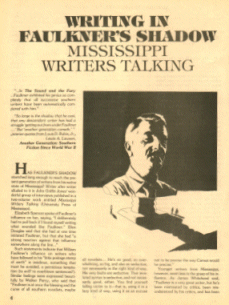 “... In The Sound and the Fury ... Faulkner exhibited his genius so completely that all successive Southern writers have been automatically compared with him.” “... In The Sound and the Fury ... Faulkner exhibited his genius so completely that all successive Southern writers have been automatically compared with him.”
“So large is the shadow that he cast, that any descendant writer has had a struggle ‘getting out from under Faulkner...’ But ‘another generation cometh.’”
(interior quotes from Louis D. Rubin, Jr.)
- Lewis A. Lawson
Another Generation: Southern Fiction Since World War II
HAS FAULKNER’S SHADOW stretched long enough to reach the present generation of writers from his native state of Mississippi? Writer after writer alluded to it in John Griffin Jones’ wonderful group of interviews published in a two-volume work, Mississippi Writers Talking (University Press of Mississippi).
Elizabeth Spencer spoke of Faulkner’s influence: “I deliberately had to pull back if I found myself writing what sounded like Faulkner.” Ellen Douglas said that she had at one time imitated Faulkner, but that she had “a strong reaction against that influence somewhere along the line.”
Such statements indicate that William Faulkner’s influence on writers who have followed in his “little postage stamp of earth” is insidious, something that must be avoided, a pernicious temptation (to evil? to overblown sentences?). Similar feelings were expressed beautifully by Walker Percy, who said that “Faulkner is at once the blessing and the curse of all Southern novelists, maybe all novelists. ...He’s too good, so overwhelming, so big, and also so seductive, not necessarily in the right kind of way. His very faults are seductive. That involuted syntax is seductive, and not necessarily good, either. You find yourself falling victim to it – that is, using it in a lazy kind of way, using it as an excuse not to be precise the way Camus would be precise.”
Younger writers from Mississippi, however, seem less in the grasp of his influence. As James Whitehead said, “Faulkner is a very great writer, but he’s been mistreated by critics, been misunderstood by his critics, and has been used as a way to stifle anyone who might have grown up in his shadow. That’s something he would’ve never done, never! ... Faulkner is like the humidity in Mississippi. You don’t avoid Mr. Faulkner, you grow up with him.
On the occasion of “Mississippi Writer’s Day” – a celebration of the publication of Mississippi Writers: Reflections of Childhood and Youth (vol. 1, 1985) – we asked some of Mississippi’s young writers to comment on the topic, “Writing in Faulkner’s Shadow.”
Jes Simmons
Emerson asked, “Why should not we also enjoy an original relation to the universe” Whitman warned, “You shall no longer take things at second or third hand, nor look through the eyes of the dead.” And Twain stated, “I don’t take stock in dead people.” Although it’s somewhat self-defeating to quote these past writers urging their readers to live in the present, what they were telling their generation applies to contemporary Southern writers writing in Faulkner’s shadow.
Faulkner has strip-mined Mississippi’s past. There’s nothing there for us. We should – and we must – move on. Walker Percy sees the necessity of writing about the suburbs, the shopping malls, the “black Leonardos” of the contemporary South. Faulkner scholar Floyd Watkins points out the need today for annotated editions of Faulkner, even for college students from the South – Bayard’s Coke is not the Real Thing.
Faulkner’s shadow? I’m having more trouble writing under Barry Hannah’s!
Barry Hannah
Here’s something on Faulkner that might do. Just wrote it the other day before I read your letter – lucky happenstance.
Percy, Lamar – these are the famous names here, along with Faulkner, the ghost who walks back and forth through my room with the idiot Benjy on a leash, drooling through the fence at the coeds with their sunbrowned legs and arms all bare and delicious, just like I do. I got my crushed flower in my hand somebody gave me, and I stare slobbering into the fire of my own heart. (from Never Die, a book in progress)
Howard L. Bahr
I disagree that “all Southern writers... write in Faulkner’s shadow.” Those who do must evidently choose to do so, must make a conscious choice to batter their heads against the great monolith of Faulkner’s canon. And anyway, to worry about it seems to me a great waste of creative energy; energy that could be better applied to one’s own vision of the world.
I reckon there was a time when I was inclined to fret about dwelling in Faulkner’s shadow. Then I discovered it was simply imitation, and very poor imitation at that. I would read him, and imitate. Then I would read Scott Fitzgerald, and imitate him for a while. Then Thomas Wolfe. Then Ray Bradbury. Whoever I was reading was who cast the biggest shadow at the time. Then I learned two things: that a writer has to imitate, if only to find a point of departure; and that to worry about it is to surrender to self-consciousness, something no writer can afford.
If a man tells a tale, in the best way that he can, that is enough. That is all he ought to worry about. He will not be telling anything new, so he can’t worry about that. And if at first he uses another’s voice, he can’t worry about that either – so long as he keeps trying to find his own. That is the thing: to find your own voice. When you accomplish that, you will dwell in no one’s shadow but your own.
One of Faulkner’s characters said that “the past is not dead, it’s not even past.” He was wrong, at least so far as Southern writers are concerned. Many of the things Faulkner wrote about are past, are dead, to the Southern writer. He can’t use them anymore, and if he tries he will not tell them as well as Faulkner did. So he has to look to his own world, his own South, and find what is there. I think he will discover that now a writer is Southern only in terms of milieu, of landscape. He writes about the South because that is what he knows, what is handy to him. But the issues he deals with, the themes that move against that landscape, must be universal – must strike responses outside the Southern sensibility. There is material enough there for the rest of time, and room enough for us all.
Larry Johnson
I tend to write long, involved sentences, but I don’t think it’s because I’ve read some (by no means a lot) of Faulkner’s works.
It seems to me that today’s young Southern writers are faced with such an overwhelming barrage of literary influences, distractions, and annoyances that Faulkner probably gets lost in the shuffle most of the time.
On the one hand, there are wonderful writers one might want to emulate (Nabokov, for instance, who was contemporaneous with Welty and Percy yet unknown to them when they began their careers; or Cormac McCarthy, one of today’s greatest artisans of the English language); but on the other hand there are many, many more authors one wants to avoid imitating (horrendously bad and bland scriveners like Colleen McCullough, for example, or monoliths of often incoherent megahype like John Barth). Between these ecstatic heights and dismal pitfalls lies a precarious path, and perhaps Faulkner should be merely a bright star overhead lighting the way and reminding us of the neglect his early works suffered, and of the vindication of history that good and great writing will last, whereas fashionable, clever, and media-managed writing will not.
Jack Butler
“Writing in Faulkner’s Shadow.” That’s a metaphor. It implies he blocks the light. What light does he block, then?
For me, Faulkner, like any good writer, is a source of light, not an impediment to it. He may have his windy passages, his grandiose simperings, but he touches the quick and the true time and time again, he shows me not only the lives others have lived, but my own life. One of the results of that is that writing itself is illuminated for me.
So there is no shadow. Maybe there is an occultation – one source of light may occlude another source from one angle only. There is that with Faulkner – that publishers and critics and reviewers and the public may not be able to see past Faulkner, may not see the rest of us down here. There’s not much you can do about that sort of thing, so there’s no point worrying about it. I would think there would be even less point desperately trying to derive a style that is dramatically non-Faulknerian. There is much in Faulkner that is counted as “Faulknerian” which is really Southern. Any Southerner has to recognize some of it, and any Southern writer has to use some of it.
Maybe writers have another worry, to extend the metaphor, maybe we fear that he, like a black hole, has sucked up all the useable matter in the vicinity. But to think so is to underestimate the wild and wicked variousness of the world. Not to mention the, so to speak, naked singularities of the minds of writers, from which very nearly anything may emerge.

copyright © Alec Clayton 2002
|

