|
Everything for Everybody
by Alec Clayton
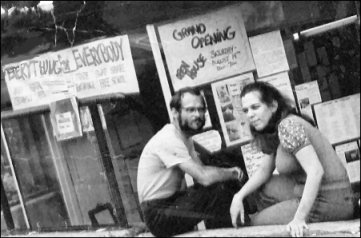 |
Gabi and I in front of the Albany Branch of Everything for Everybody
summer 1976, soon after Noel was born. |
It was my 30th birthday, February 17, 1973, and I felt like I was up the proverbial creek and watching the dropped paddle go floating downstream. I had left a part-time job in a synagogue for a slightly better paying job in a flocking factory near Washington Square. Flocking is the fake snow they put on Christmas trees. We flocked cute little teddy bear and ballerina lamps. Later I would joke that I had been the best flocking flocker in the whole flocking factory, but at the time that job was no joking matter. I was going crazy there and I had to find a way out. This was NOT what I had come to New York for! But the boss loved me. He saw me as the son he’d never had and said he’d like to train me to eventually become a partner in the business and maybe one day take over. The prospect scared me to death.
I had an interview on my birthday for a job teaching art in a private school on Long Island. The interview did not go well. They were looking for people with experience teaching ceramics, which I had never done and which had not been stated in the job announcement. They said they would keep me in mind, but I knew better. And it ended with me stranded at a railway station in a snow storm, which I saw as an omen that I had to do something radically different. And I remembered an intriguing ad I had seen in the Village Voice, which just might be the radical change I needed. The ad said: "If you want to rent an apartment or have one to rent, if you are looking for work or want to hire someone, if you need to buy, sell, rent or trade anything, if you are looking for a friend or a roommate – whatever you may want or need, there is one organization in the world that can do anything for anybody, and that organization is Everything for Everybody."
I took myself down to the place. It was a tiny storefront on 8th Avenue right around the corner from the meat packing district and near another kind of "meat market," the leather bars on the waterfront. The store was no larger than the dining room in your average suburban home. A plate glass window in front was filled with hand-lettered signs promoting everything from jobs and apartments for rent to encounter groups to cooperative daycare and a food co-op. I had arrived at hippie heaven in a box. A wooden bin outside was filled with old clothes, toys and canned foods. A sign on the box said: "Take Some. Leave Some." Through the window I could see a man sitting at a desk reading a newspaper, a cup of coffee in hand. He was bald headed and casually dressed, not a hippie after all, but a man who looked like someone’s kind old uncle.
I walked in and introduced myself. The man was Jack Scully, founder of Everything for Everybody (popularly referred to as EFE). Jack directed me to information explaining how the organization worked – mostly in the form of notes on index cards and a profusion of hand-lettered signs like the ones on the window. For an absurdly cheap membership fee you could list jobs, things for sale, items for trade, skills offered, etc., etc., in short, everything for everybody. There were various discussion groups and classes that were run by members, and there was a newspaper published by the organization; there were members who were trying to form a food co-op and day care center, and there were members who worked at all kinds of odd jobs. The listings included such strange things as a blind sculptor seeking models and classes in how and where to scrounge the best treasures from New York’s trash bins.
I paid my five bucks for a one-month membership and soon started picking up odd jobs. Among the jobs I got were house painting, delivering flyers and being a companion to a man confined to a wheel chair (he needed someone to push his chair, but mainly he just needed a friend). It was like working through the day labor pool except I was my own boss, and I soon learned that people were willing to pay what to me was a decent wage for my work.
Then I met Mike T, who had previously gone by a different name and was soon to change his name yet again to Mike Scully, thus christening himself Jack’s honorary son. Mike was a short, muscular man who wore a gaucho hat and braided his long black hair. He was a talented writer, a good cook, and (as he put it) a "fair-to-meddling" carpenter. He claimed to have been a poet protégée whose mentor was Carl Sandburg. He also claimed to have been a member of the Weather Underground and said he was wanted by the FBI, which was why he was going by an alias and why he carried a gun.
Mike headed a small crew of carpenters and house painters that he called, variously, The Midnight Carpenters, TAANSTAFL (an acronym for There Ain’t No Such Thing As A Free Lunch), and Uncle John’s Band (named after a Grateful Dead song and in tribute to Jack Scully whose real name was John). Shortly after we met, he asked me to join his crew. Mike and his friend Sam also worked on the EFE newspaper. Sam was the editor. Mike and Jack wrote most of the articles. Nobody got paid. They asked me to help, and after one issue Sam asked me if I would take over as editor because I was the only person who could do paste-ups without getting everything crooked.
A few months later Jack rented an old building around the corner in the meat market district that had been used as a restaurant. There was a counter and stove and refrigerator inside. Jack wanted to serve free meals to the poor, or as he called them, the street people. Mike and I told Jack that if he’d let us live in the back of the store we’d help him run the place. Jack accepted the offer but said Mike would have to get rid of his gun, which he did. He ceremoniously threw it in the Hudson River.
With the help of half a dozen EFE members, we scrounged up furniture, built shelves, painted signs, set up the newspaper operation and living quarters in a back room, an area for the food co-op in a middle room, and a lounge area for entertainment and relaxation in the basement. Carrying everything by hand and using borrowed hand trucks, we moved from the old store in a single day.
The very next day we started serving soup to the street people. The soup line opened at four o’clock daily. For members, free food and coffee was available anytime during the day. We put a donation box on the counter, and we asked members to help us by getting restaurants to donate leftovers. Whichever members happened to drop by with time on their hands would chop vegetables, stir the pot, and in general help out with whatever was needed. Jack put a sign up over the stove quoting St. Paul: "He who will not work, let him not eat."
A member named Naomi came in not long after we opened the new store. Naomi was an older woman – older to me, at least; she was probably in her fifties at the time. After talking to her for a few minutes, I told her that we were having a party in the basement that night and she was welcome to join us. She asked if she could bring her daughter. Pointedly looking at me she said, "She needs a man."
She did bring her daughter, Gabi, and introduced her to me. Naomi left the party early. Gabi never left.
One day shortly after opening the new store Jack announced that he was going to start running the store 24 hours a day, and he invited a select group of members to become live-in staff. We would scrounge food and clothing for the poor, cook, clean, run the food co-op and day care and various classes, and sell ads for the newspaper. We would not be paid, but we could live in the back of the store and eat the food we served to the poor. He called it "the hardest job you'll ever love."
We started with a staff of about half a dozen: Mike and I, a strange woman named Wanda who was Mike’s girlfriend at the time, Melinda, Gabi, and one or two others who quit very quickly, never to be seen again.
We converted shelves in the back room into makeshift beds, built a shower, and worked around the clock on constantly changing schedules. It was hard, hard work, and we loved it.
Wonderfully strange people made EFE their home away from home. We had parties every weekend – street dances, jam sessions with anything you could beat on used as percussion instruments, badminton in the street after the meat markets closed down for the day, impromptu parades through Greenwich Village. But it was far from being all fun and games. Young people who had escaped neglectful or abusive homes came to us for shelter. People came who needed friendship, people who were suicidal, mental patients recently released from the psychiatric ward of Bellevue Hospital, victims of spouse abuse, recovering alcoholics. Whatever they needed, we were there for them.
Jack was a recovering alcoholic. He had been sober for about six years at the time he started EFE. He was also a devout Catholic who had once tried to become a priest but had been booted out of seminary for what was called "imprudent zeal," i.e., pamphleteering against Joseph McCarthy and his Communist witch hunt. He had also worked with and been tremendously influenced by Dorothy Day and her Catholic Worker movement. Our work at EFE was patterned after the Catholic Worker and Alcoholics Anonymous. Jack wrote a column in the newsletter called "One Day at a Time," the AA slogan. He told the staff members that our job was to love one another (meaning all of the members and the street people who came in for help). To love, he said, was to do for another with no hope or expectation for personal reward.
Jack had never lost the religious fervor that had sent him to seminary. He practiced an extremely liberal brand of Catholicism, and EFE was his ministry. He proudly proclaimed that God had kicked him out of seminary so that he could serve Him in a more meaningful way than running Bingo games, which he believed would have been his fate if he had gone into the priesthood. (Meaningless assignments, he believed, was the church’s way to rendering radical priests ineffective.) In a strange way – considering that he was liberal to the point of being, as he put it, "a little to the left of anarchy" – Jack was a fundamentalist. Like Christian fundamentalists on the other end of the spectrum, he chose the passages of scripture he felt were essential and interpreted them literally. He believed that he was put on this earth to feed the hungry and clothe the naked and comfort those who were sick and in prison. He believed that if he loved others with no expectation of reward that God would provide him with whatever he needed. He lived that belief, and he demanded that we do the same. Demanded is not too strong a word. Jack called himself a benevolent dictator, and he was.
A young woman came in one day and said to Jack, "What is this place?"
Jack answered, "It’s the place where your dreams come true."
That woman dreamed of being a dancer. At Everything for Everybody she got a chance to dance. She performed for the other members. It may not have been a Broadway stage, but she was able to dance in front of an appreciative audience. I don’t know what happened to her after she quit coming to EFE after a few months, but I would like to think that experience gave her the practice and self esteem she needed to continue working toward fulfilling her dream. There were hundreds like her who came to EFE during those first months and found something there that they needed. For many of them, it was a place where dreams came true.
In June of that first year Gabi and I got married in the basement of EFE. We wrote our own vows and Jack officiated at the ceremony. Gabi’s dress was donated, as was the wedding cake and decorations for the event.
Someone donated a wooden arbor that we set in the basement, and we said our vows standing under the arbor. Thirty-seven years later our son built an identical arbor based on photos from our wedding, and used it in his own wedding. After his wedding he gave it to us, and it stands in our back yard today.
On the day of the wedding I had one job I was responsible for. There was a drainpipe in the basement with an overflow basin that had to be emptied daily. My job was to make sure it was emptied right before the wedding. I forgot, and it overflowed. Right after saying "I do," I had to mop up the basement. Then we all went upstairs to dance in the street.
Ours was the first of four weddings among staff members to take place that summer. A year later there were three infants that we took turns strolling through the streets of the Village in a shopping cart.
Mike T. and his girlfriend were one of the couples that got married that summer. They didn’t remain on staff much longer. Nor did they stay married for very long. They moved out immediately after their wedding and got divorced within a few months. Getting divorced was easy, since none of the weddings were legal.
Another Mike came onboard, Michael H. He married Melinda. Mike was the staff photographer, and the pictures he took for our newspaper comprised a wonderful visual record of those early years.
Everything for Everybody quickly outgrew the building we were in. We began opening branches in other parts of the city. Mike and Melinda ran the new branch on the Upper West Side, and Gabi and I ran the East Village Branch. Then we branched out farther. Jack bought a farm near Brant Lake in Upstate New York that was run as a retreat for members, and we opened a branch in Albany.
In the summer of ’76 we leased a loft around the corner from the West Village branch that we used solely for housing the homeless. It had previously been an after hours club dedicated to "water sports." It was called The Toilet. There was a gigantic painting of a naked man over what had been the bar, and there was a stage upon which sat four or five doorless bathroom stalls. Apparently that was one of the gimmicks that attracted people to The Toilet, men doing whatever it was they did in bathroom stalls on stage for the entertainment of all.
We painted over the nude and converted the stage into real bathrooms and showers (with doors). We scrounged up countless wooden skids that we used to build partitions and bunk beds. I can’t remember exactly how many "rooms" and how many beds there were, but I think we housed around fifty people a night. Ours was the only shelter in the city that was not segregated by sex. It was the only place where families could get shelter together. It was also the only shelter in the city that received no government or foundation money (Jack would not accept the strings that came along with funding).
A homeless man named Alan became an institution at EFE. As nutty as the nuttiest nuts there, Alan was obsessed with trains. He had memorized the schedules of every train on the East Coast and would recite them constantly. He also periodically wrote letters to the White House threatening to kill the president’s daughter. The FBI would come to investigate him and, upon realizing very quickly that he was a harmless nut, would have him committed to Bellevue Psych. Interestingly, he always managed to get himself committed right before cold weather set in, and then improve enough to be released in the spring, when he alternately lived at EFE and slept in the subways.
Alan had a pair of green tennis shoes that he wore in the summer. The dye from the shoes would turn his feet green. One day policemen came by to investigate a mugging that had happened nearby. They asked Cathy, one of the staff members, if she had seen anyone suspicious looking hanging around, "You know, anyone that looks strange." Cathy pointed at Alan who was sleeping on a mattress with his green feet sticking out and said, "That guy is about the most normal-looking person here."
Things began to change. The free-spirited hippies and idealistic youth who had made our communal living experience so much fun began to drift away, and in their place there were more and more street people, drunks and mental patients. They were not so easy to love. Gabi and I began to long for a more peaceful existence, and I wanted our children to be closer to their grandparents back in Mississippi. By then we had Noel, who was a year old, and Gabi was pregnant with our second child. We began to plan our escape, trying to figure out how to leave without abandoning our commitment to serving the poor, which we believed was a calling we could not give up.
One day we were in a coffee shop on 8th Avenue. Gabi said she had to go out to get a pack of cigarettes. I waited while she walked to a nearby store. While walking along the avenue a stranger met her and reached out and slapped her in the face – no provocation, no warning. He just slapped her and kept on walking. Gabi came back to the coffee shop in tears and told me what happened. That was the final straw. We decided that was our sign that we had to get out of New York. The city was getting too weird even for us.
So we moved to my hometown in Mississippi, where we opened a branch of Everything for Everybody. The day we opened it, two men came by. Gabi said as they got out of a car: “Here come the police.” She was right. The cops insisted we close down because we didn’t have a license for the business. Need I say that getting a license for such a business in Hattiesburg, Mississippi was impossible? I told the cop that we hadn’t needed a license in New York and that it wasn’t really a business, which was not the smartest thing I could have said. He replied, "This ain’t New York."
We eventually found a way around the licensing problem and opened it again under a different name, but that’s a whole other story.
For a number of years we called Jack every year on the anniversary of the opening of EFE. In about 1985 some of the members who were living at EFE formed a tenants union and forced changes that Jack couldn’t abide with (hearing about it second hand, I never understood the details). Nevertheless, Jack refused to accept the changes. Instead, he shut the whole thing down and started over in a tiny store front in the East Village. The only person who lived in the store then was crazy Alan, who slept in the back and swept up and ran errands for Jack. We went back for a visit in ’86 and found Jack perfectly happy with his new scaled-down operation. Eventually we lost touch with him. In the early 1990s we heard from a former staff member that Jack had died all alone in his apartment in the Village.
Note: I tried to write the history of EFE but was never able to do it to my satisfaction, I did include a fictionalized version of the story (greatly expanded on this) as a small part of my novel Imprudent Zeal: https://mudflatpress.com/portfolio-item/imprudent-zeal/.

copyright © Alec Clayton 2004-2021
|

